Showing posts with label Intelligent Design. Show all posts

Thursday, April 17, 2008

The Question Deserves an Answer

As I’m watching The Daily Show and The Colbert Report, there are seemingly endless commercials for Ben Stein’s creationist movie, Expelled. In the commercial, Stein is a student in a classroom where his instructor tells the students that evolution is unguided and undesigned. “How did life begin in the first place, dude?” Stein whines in his trademark monotone. This question is supposed to be terrifying to his professor--so terrifying that Stein is, you know, expelled.

It’s not like we have no idea. There are many competing hypotheses that attempt to explain the origin of life. Although scientists don’t necessarily agree on what it means to be alive, there is agreement that living organisms arose from non-living material in a long, slow process—there was no single moment when the first cell “sprang to life.” Hypotheses about the origin of life, collectively called abiogenesis, differ on which component of living cells arose first. Some postulate that some sort of cellular membrane had to arise first. Others suggest that self-replicating genetic molecules must have formed as the initial step toward life. One of the most widely cited hypotheses is the RNA-world idea, which says that short segments of RNA similar to modern ribozymes were the first components of cells to arise. Ribozymes are bits of RNA that are just large enough to self-replicate and to catalyze simple metabolic reactions. Another category of abiogenesis hypothesis proposes that simple metabolic pathways were the first step toward life. One particularly attractive hypothesis suggests that the reverse citric acid cycle was the original metabolic pathway and would have used ambient energy, perhaps from volcanic vents, to assemble the organic chemicals needed for life to begin.

The short answer to Stein’s question is that we don’t know how life began. However, this doesn’t mean that a supernatural explanation is necessary. The question of the origin of life is not scary to real scientists. The “intelligent design” idea that Stein endorses answers every question with “God did it.” From a scientific point of view, this is no answer at all.

Tuesday, August 21, 2007

A Philosophy Dressed Up as Science

There seems to be a relationship between right-wing politics and ignorance about science. Here, Tom Bethell in the conservative tabloid The American Spectator displays a complete lack of understanding of basic evolutionary theory (or willfully obfuscates evolutionary science for political reasons). Bethell is a journalist who feels that he has the expertise to declare that HIV doesn't cause AIDS, that global warming is a lie, and that evolution is "best seen as a 19th Century philosphy--materialism--dressed up as science."

In his article, Bethell derides evolution in part because it can be used in "support of any cause whatsoever." Indeed this is true. It is also true that Christianity, which is the opposite of evolution in Mr. Bethell's estimation, has been used to justify war, slavery, genocide, rape, and any number of crimes against humanity. Bethell would be horrified--and rightly so--if I claimed that Christianity is to blame for every evil perpetrated by its adherents. His invocation of misuse of evolutionary theory is a non sequitur.

Bethell's treatise is loaded with such non sequiturs, along with misconceptions and fabrications about evolutionary theory. The most egregious:
The underlying problem is that a key Darwinian term is not defined. Darwinism supposedly explains how organisms become more "fit," or better adapted to their environment. But fitness is not and cannot be defined except in terms of existence. If an animal exists, it is "fit" (otherwise it wouldn't exist). It is not possible to specify all the useful parts of that animal in order to give an exhaustive causal account of fitness. If an organism possesses features that appear on the surface to be inconvenient-such as the peacock's tail or the top-heavy antlers of a stag-the existence of stags and peacocks proves that these animals are in fact fit. So the Darwinian theory is not falsifiable by any observation. It "explains" everything, and therefore nothing. It barely qualifies as a scientific theory for that reason.
This same tripe has been trotted out in creationist arguments before. It might be convincing if it were correct, but unfortunately for Bethell, it isn't the least bit true. Scientists don't define fitness as a quality or trait that allows an organism to be successful--such a quality is an adaptation. Fitness has a precise definition: the ability of an organism to get its genes into the next generation. Such an ability can be quantified and measured. Adaptations may contribute to fitness, but they're not the same thing. (Wikipedia has a pretty decent explanation of fitness.)

It's not surprising that Bethell doesn't understand the difference between adaptation and fitness; it's clear from his writing he doesn't understand the difference between science and religion. He claims that Intelligent Design is "informed" by science, and if by that he means that it uses scientific words to dress up pseudo-scientfic mumbo-jumbo, then I guess it is. So is astrology. Bethell toes the company line on Intelligent Design "theory":
Intelligent design is...aggressive and therefore potentially dangerous. It says to the Darwinians: "You don't have the evidence to support your claims. Your lab results and fossils don't support your theory. Organisms are way too complex to have arisen by chance. Take all the time you want, it won't be enough. Even though we don't know how it happened, these critters must have been designed somehow."
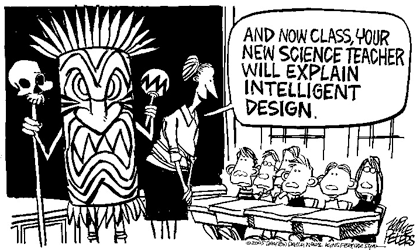
Bethell is right--the IDers are aggressive. Their idea is also dangerous, since it threatens the teaching of real science in public schools. ID makes provocative claims about evolution, but they're easily shown to be baseless--fossils don't support evolutionary theory? Such a thing would be said only by someone who's never looked at a fossil. Complexity as an argument against evolution is nothing more than an argument from incredulity: "I don't believe anything so complex could possibly evolve." Intelligent design is indeed a philosophy dressed up as science. Here is another part of the intelligent design movement that Bethell gets right: They "don't know how it happened." That's the difference between IDers and evolutionary biologists. We do know how it happened.

Friday, August 3, 2007

Colbert 1, Behe 0

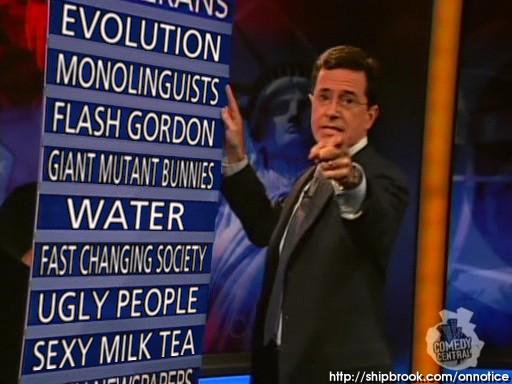
Stephen Colbert is not a fundamentalist zealot--he just plays one on TV. He's also not an economist, or a politician, or a scientist, but he has the ability to look right through specious arguments of these people and skewer them to humourous effect on basic cable television. His victim last night was Michael Behe, the grand poobah of the Intelligent Design movement. Behe was on Colbert's show plugging his new book, which better minds than mine have already torn to shreds (here and here, for instance). Behe's a jovial sort, and he seemed relaxed and in his element; after all, Colbert had said twice that all he wished to do was agree with Behe that God had created the universe in its present form. Behe apparently has never seen the Colbert Report. He launched into his tired (and repeatedly discredited) mousetrap analogy--that even a simple mousetrap is useless if one of its parts is removed, and so is an example of irreducible complexity.

Colbert is not an athiest--he famously teaches a Sunday School class at his church--but he's also not a fool. When Behe stated that dismantling a mousetrap would leave only a wire, a spring, and a block of wood, Colbert gave exactly the right response: "And of course we know, none of those things is even remotely useful." This gets right to the heart of the problem with irreducible complexity. Even if it is true (and it usually isn't) that some complex structure or metabolic pathway won't work without all its components, it doesn't mean that those components are useless in and of themselves. For instance, one of the favorite targets of the ID crowd is the bacterial flagellum, a structure seemingly so complex that it can't possibly work without all the parts. However, recent study indicates that parts of the flagellum are identical to mechanisms used by some bacteria to attack others. In other words, the flagellum was put together out of parts of other mechanisms being used for unrelated purposes. It should be obvious to any idiot that the individual parts of a mousetrap have other uses. It was obvious to Colbert; it wasn't obvious to Behe.