 I'm finally recovering from a week spent in the Florida Panhandle with the Marine Biology class from my university. I've been going along each year for the last four years to drive one of the vans and to point out the odd bird to interested students. The best bird this year (or at least the best-looking bird) was a male black-bellied plover in full breeding plumage. Late May seems a bit late for him to be in Florida--he should be in the High Arctic chasing girls. Perhaps I shouldn't be surprised that he made the same choice as me--enjoying the sun in Florida is more inviting than returning north and going to work.
Showing posts with label Birds. Show all posts
Showing posts with label Birds. Show all posts
Wednesday, May 21, 2008
Back From Florida
I'm finally recovering from a week spent in the Florida Panhandle with the Marine Biology class from my university. I've been going along each year for the last four years to drive one of the vans and to point out the odd bird to interested students. The best bird this year (or at least the best-looking bird) was a male black-bellied plover in full breeding plumage. Late May seems a bit late for him to be in Florida--he should be in the High Arctic chasing girls. Perhaps I shouldn't be surprised that he made the same choice as me--enjoying the sun in Florida is more inviting than returning north and going to work.

Sunday, September 23, 2007
Evil, Sinister Ducks
As an ornithologist, I generally love all birds, but this video is making me rethink my position on ducks.
Friday, June 15, 2007
Michael Chertoff Tries to Ruin My Day

When I look back over my life, which has been pretty good overall, I sometimes think of days that stand out above the rest. Every great once in a while, I’ve been lucky enough to experience a day that was spectacularly good, from start to finish. One of those days took place at a tiny patch of thorn forest on the Rio Grande River, the Santa Ana National Wildlife Refuge in extreme southern Texas.
Before I was a biologist, I began watching birds, and I read about the spectacular birding in the Rio Grande Valley of Texas. In March of 1991, Mrs. Archaeopteryx and I loaded our binoculars and field guides in our Jeep and headed for Brownsville. Along the way, we saw whooping cranes at Aransas Refuge, and shorebirds at Laguna Atascosa. We visited the Brownsville City Dump to see Mexican (now Tamaulipas) crows, and stopped at a chicken farm to look for crested caracaras at the place where the farmer tossed his dead chickens (we refer to this spot as the “dead chicken ranch”). In Brownsville, we saw buff-bellied hummingbirds at the Sabal Palm Grove sanctuary. But the highlight of the trip was Santa Ana.
We arrived at the refuge early in the morning. Before we got out of the parking lot, we were racking up “life birds” (birdwatchers tend to keep score—any bird you’ve never seen before is a life bird), and as we walked around the pathways of the refuge it became difficult to keep up with all the new birds. We were seeing birds that we didn’t even know existed. Ever heard of a fulvous whistling-duck? We saw some. Least grebe? They were common. Olive sparrows, green kingfishers, tropical kingbirds, and black-bellied whistling ducks all hid in the underbrush or around the impoundments.
We had planned on spending a couple of hours at the refuge, but ended up spending the entire day. At one point, after we had decided to skip lunch to keep birding, I tried to take a picture of a great kiskadee (a type of large, colorful flycatcher, pictured above) who kept teasing me by flitting to the exact opposite side of the bush where he was perched. While I leaned out over the side of the impoundment where the bush was located, my wife pointed out the swarm of ants crawling on my shoe. “Weren’t there signs warning about fire ants?” she asked. The ants were biting me, but it didn’t seem to hurt much. “If these are fire ants,” I said, “they’re overrated.” I’d find out later that night, in our hotel room, that it sometimes takes a while for the “fire” part of the name to be appropriate.
At one impoundment, we watched while a more experienced birder attempted to lure a king rail out of the cattails by making a loud clicking sound. As we waited, other folks came up the trail and excitedly told us about a young jacana who was walking across the lily pads at a nearby pond. Jacanas are gangly-looking shorebirds that are common in Central America, but rare farther north, and we were very lucky to see it.
As we hiked around the refuge trails, we got caught in a sudden downpour, and we raced ahead to a photo blind to take shelter. On the other side of the blind was a feeding station, set up to attract birds out into the open for tourists to see, and we saw exotic-looking green jays and funny little inca doves gobbling up the seeds and cracked corn. After the rain passed, we were determined to finish hiking every trail in the refuge. Unfortunately, the rain turned the trails to mud, and every step we took recoated our sneakers with six or eight inches of sticky, black goo. It grew extremely hot and humid, but we pressed on. Around us, plain chachalacas, odd birds that looked like a cross between a turkey and a hawk, laughed their raucous call at us; we had seen a couple skulking through the underbrush before, but now there seemed to be thousands of them, incessantly mocking us and our slow, muddy progress. Finally we made it back to our car, exhausted, soaked, muddy, hungry, ant- and mosquito-bitten, and maybe as exhilarated as either of us had ever been. We've been back to the refuge several times, and we've always had a great day, but never one as spectacular as our first trip.
What made me think about this fantastic day was a news item I heard today on NPR. As part of its solution to the immigration "crisis" (the ongoing distraction from more important things), the federal government has decided to build a 20-foot tall wall at intermittent points along the Rio Grande in south Texas, apparently including a section through the middle of the Santa Ana refuge. Despite the fact that no one in south Texas wants the wall, that no one believes that the wall will keep illegal aliens out, and that no one knows what the wall will do to the Texas economy or environment, the Department of Homeland Security is going ahead with the building. Biologists at the refuge are worried about the effects the wall will have on the last remaining population of endangered ocelots in the United States. Unfortunately for the ocelots, Michael Chertoff apparently thinks that this wall is important to keep the nation safe from landscapers and nannies (meanwhile, as Letterman likes to say, no word yet on Osama bin Laden).
Thursday, June 14, 2007
"Bob-white?"
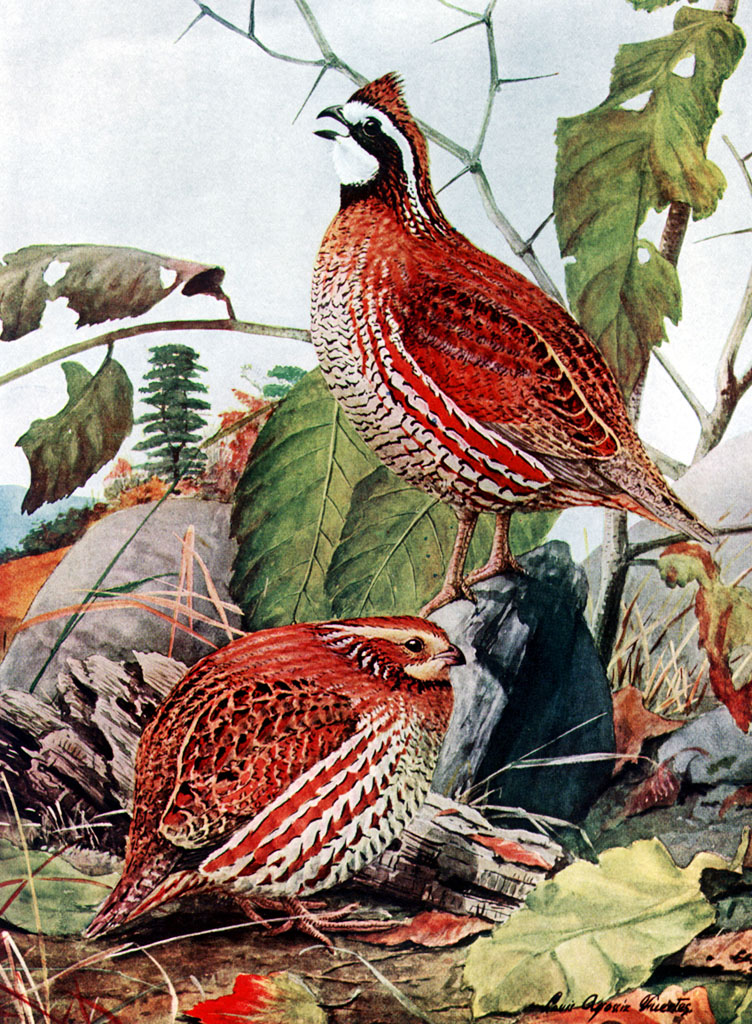 This is not news to those of us who pay attention to this sort of thing. Numbers of some of the most common birds are dropping precipitously. Northern bobwhites were quite common in the part of Arkansas where I grew up 40 years ago--now they're rare. What's causing the decline? Habitat destruction, introduced species, pesticides, overharvesting--the usual suspects. Because they're ground nesters, bobwhites may be particulary susceptible to fire ant invasion.
Bobwhites are cheery birds; their perky little whistle was one of my favorite sounds when I was a child. When he was a teenager, my dad raised bobwhites to sell, but grew attached to them, and wasn't able to sell them for their intended use, training bird dogs. Had he lived to see it, he would have been proud of the fact that I studied bobwhites for my master's degree.
Lots of places in Arkansas look like good habitat for these quail, but most often, they're conspicuous by their absence.
Tuesday, June 12, 2007
"Exotic" Isn't Always a Good Thing.
 The bird in the picture next to this post is a common myna (Acridotheres tristis), a native of southeastern Asia. The picture was taken by me on a Marine Biology field trip. Unfortunately, the trip wasn't to India, but to Florida--I snapped the picture in a Wal-Mart parking lot in Homestead. Florida cities have more birds than do many. Among the most common birds I saw were mynas, collared doves, rock pigeons, starlings, monk parakeets, cattle egrets, house sparrows, and house finches. If you know anything about birds, you know that not one of those species is native to Florida. In fact, Florida has had reports of nearly 200 species of exotic birds. Many of them are known only from a sighting or two, but others, including all of those listed above, have established breeding populations in Florida. Many of these birds are escaped pets--or worse, pets that have been released into the wild by owners tired of caring for them.
So what? Why should we care if a new bird or two is introduced into an area? Exotic birds compete with native birds for food and nesting space. For example, many authorities blame the decline in populations of native bluebirds on the fact that starlings and house sparrows outcompete them for the best nesting sites. Non-native birds may carry infections to which native birds lack any immunity. Non-native birds (such as parakeets and mynas) may act as agricultural pests. If they hybridize with native birds, non-native birds may dilute the gene pool of native birds.
The problem of introduced exotic species receives less attention than some other environmental maladies, but it has the potential to cause great harm to natural ecosystems, and to human activities. Everyone has heard stories of the problems caused by zebra mussels, fire ants, tiger mosquitoes, and killer bees; stories of more bizarre exotics (such as monitor lizards, pythons, and monkeys) are less well known. Despite this, people still seem to ignore the exotic pet trade. Apparently folks in Louisiana are all excited about the possibility of selling red-eared sliders as pets, even though there is the possibility of the turtles carrying salmonella, the turtles don't live very long in captivity (they have the potential to live 40 years in the wild), and no one has determined just what increased pet trade will do to the wild populations. No one seems to be worried about the effects released turtles might have in areas outside their natural range.
Here's the deal: We already have dogs and cats, and they do enough damage to the environment. There is absolutely no need for people to have more exotic pets. This isn't about the "rights" of pet owners--you DO NOT have the right to put your local ecosystem at risk. If you need a pet, shelters are full of cats and dogs that need you, too. Do everyone a favor--pass on the baby alligator. Skip the boa constrictor. Leave the parrots where they belong.
Sunday, June 3, 2007
The Neverending Story--Now with Dinosaurs!
Here is another small skirmish in the neverending war between those who believe that birds are direct descendents of a group of theropod dinosaurs, and those who believe that birds and dinosaurs shared a common ancestor, usually said to be a thecodont reptile. For many, this is thought to be settled science--for example, see the Wikipedia article on the origin of birds. However, a few holdouts, led by Alan Feduccia, continue to maintain that there are many problems with the dinosaur-origins theory. Feduccia presents a strong case against dinosaur origins in his book The Origin and Evolution of Birds. This debate has been going on as long as I have been studying birds; I can't imagine that it will be finally settled any time soon.
Confused creationists sometimes mistake these scientific disputes for evidence that evolutionary theory has "holes" in it. Nothing could be further from the truth. This is the way science is supposed to work--one scientist publishes his work, and others examine the work and offer criticisms.
Confused creationists sometimes mistake these scientific disputes for evidence that evolutionary theory has "holes" in it. Nothing could be further from the truth. This is the way science is supposed to work--one scientist publishes his work, and others examine the work and offer criticisms.
Saturday, May 5, 2007
You're Welcome, Wisconsin
 They were here all last weekend, but I haven't seen them in a while. The rose-breasted grosbeaks that were hanging around my feeder have departed for the north--to Minnesota and Wisconsin and Ontario, there to do their yearly business of raising more grosbeaks to send back through next year. They winter in South and Central America (like I would if I could). They zip through every year, hanging around for a week or so, cleaning out my sunflower seed in a manic hurry, gathering up energy for their trip. As my friend Hipparchia has pointed out, I feel paternal toward these birds. I don't begrudge them a crop full of seed--they pay with their flashy colors and cheerful (if somewhat nondescript) song. I also don't begrudge the birders in Wisconsin the pleasure of enjoying "my" birds all summer long--I just ask that they take care of them while they're enjoying them.
Wednesday, April 18, 2007
Like Songbirds Don't Have Enough To Worry About

Tuesday, February 27, 2007
I'm Supposed to be an Ornithologist
So much to do. So many fires to put out. Letters of recommendation to write. Scholarship applications to check out. The giant lab cleanout—which I’m only barely helping with—begins to take up some of my time. Preparing for the two summer field classes. Preparing the advertisement for the two positions we’re going to have in the department. Writing lectures for my Biogeography class. Sometimes I don’t remember the real reason I got into biology.
But this morning I got a reminder. I got to the office a little after seven. The building was surrounded by, and covered with, birds. Of course, the bluebirds that are always there were flying around the center yard. Juncos, getting darker with new plumage, flitted around the steps and darted out of my way as I moved down the walk. Yellow-rumped warblers fed in the grass. Starlings whistled on the wires overhead. House sparrows chattered under the eaves of the building. Fish crows taunted me. And the ubiquitous robins hopped across the lawn, and scolded me when I got too close.
The campus is always incredibly birdy. The cow pasture adjacent to the parking lot always has black and turkey vultures, grackles, red-wings, and meadowlarks, along with a complement of Canada geese. In the summer, there are cattle egrets. The bird feeders next to the museum attract goldfinches and chickadees. There are always mourning doves and pigeons, and the last couple of years we’ve had collared doves. The oak trees on the other side of the building attract cedar waxwings in the winter, and red-headed, red-bellied, and downy woodpeckers all year long. The pond next to the administration building usually has a couple of mallards on it, and two years ago, two black swans appeared out of nowhere and stayed for two days. Killdeer work the lawn around the Music building, and last year a red-tailed hawk spent the fall chasing gray squirrels. The day before Thanksgiving two years ago, I watched a bald eagle sail over campus.
In a couple of weeks, the barn swallows will be back, building nests on the eaves outside my office window. The bluebirds will be nesting in the center yard. They were singing this morning. The words to the song: “Get some perspective.”
But this morning I got a reminder. I got to the office a little after seven. The building was surrounded by, and covered with, birds. Of course, the bluebirds that are always there were flying around the center yard. Juncos, getting darker with new plumage, flitted around the steps and darted out of my way as I moved down the walk. Yellow-rumped warblers fed in the grass. Starlings whistled on the wires overhead. House sparrows chattered under the eaves of the building. Fish crows taunted me. And the ubiquitous robins hopped across the lawn, and scolded me when I got too close.
The campus is always incredibly birdy. The cow pasture adjacent to the parking lot always has black and turkey vultures, grackles, red-wings, and meadowlarks, along with a complement of Canada geese. In the summer, there are cattle egrets. The bird feeders next to the museum attract goldfinches and chickadees. There are always mourning doves and pigeons, and the last couple of years we’ve had collared doves. The oak trees on the other side of the building attract cedar waxwings in the winter, and red-headed, red-bellied, and downy woodpeckers all year long. The pond next to the administration building usually has a couple of mallards on it, and two years ago, two black swans appeared out of nowhere and stayed for two days. Killdeer work the lawn around the Music building, and last year a red-tailed hawk spent the fall chasing gray squirrels. The day before Thanksgiving two years ago, I watched a bald eagle sail over campus.
In a couple of weeks, the barn swallows will be back, building nests on the eaves outside my office window. The bluebirds will be nesting in the center yard. They were singing this morning. The words to the song: “Get some perspective.”
Subscribe to:
Posts (Atom)

