A couple of Fridays ago, my phone rang at nearly 9 o’clock in the evening. It was my friend Amy from Auburn, and she could barely speak. “I’ve got bad news,” she said, and then, after a sob, “George is dead.” She could say no more, and hung up. In a few minutes her husband Matt called to tell me what had happened. George and Debbie had been readying their home for their annual Christmas Trivia Party. George walked into the room where Debbie was, stopped talking in mid-sentence, and collapsed. He never regained consciousness.
George Folkerts was one of the last of a breed of biologists that we in the business call natural historians or naturalists. Field biology and ecology have become experiment oriented; George (and a few others like him) placed a much higher value on simple observation of what occurs in nature. George railed against what he called the “overmathematization” of biology, and the overemphasis on statistics and modeling that permeates the field. He believed that the best way to understand the natural world was to be outside, in nature.
George spent most of his career teaching field biology and evolution at Auburn University in Alabama. He was trained in herpetology, the study of reptiles and amphibians. Herpetologists in general tend to be the wildest of the field biologists, always eager to snatch up a poisonous snake in their bare hands or to wiggle on their bellies through cramped caves to find some rare salamander. George combined this fearless exuberance with gentleness born of a love for all living things. He was unable to limit his interests only to herps, and became an expert on insects, plants, and all manner of organisms. He and his wife became leading authorities on the ecology of pitcher plant bogs. His students sometimes called him an “omniologist,” and the legend was that he could walk (or wade, or climb) into any habitat in the southeastern corner of the country and call every organism he encountered by its scientific name. If this was an exaggeration, I never found out—I never dragged up an animal or plant that he didn’t recognize. He didn’t just know the names of the organisms, he knew how they made their living, what they ate, and what ate them.
In 1996, I was accepted to graduate school at Auburn, to study birds and mammals. When I told my undergraduate professors where I was going, they all said, “Great! You’ll get to take classes from George Folkerts!” Even those who didn’t know him personally knew him by reputation. One of my professors had been to graduate school with George. “He’s the smartest guy I ever knew,” he told me.
When I got to Auburn, I was required to take George’s class on Evolution and Systematics. George was a brilliant lecturer. He was organized, and knowledgeable, and funny. He had a deep, gravelly voice that broadcast his enthusiasm for his subject. His lectures were brimming with interesting and humorous examples of each of the concepts he was putting across, bounding from stories of a crab with markings on its carapace that resembled a human face, to sex-hungry frogs that literally mated with anything that moved, to a spider that guaranteed his mate’s faithfulness by plugging her genitalia with his own dead body. George’s classes were a joy, and nobody ever skipped a day. I made it a point to sign up for every one of his courses that I could.
One of George’s classes was called Iconoclastic Biology. This was an amazing class in which George would lecture for a while on some aspect of the intersection between evolutionary biology and human society, and then would throw the floor open for discussion. It was clear from the subjects that he chose that George was deeply interested in the human condition. He believed that people were biological entities, and as such, we could use our biology to make ourselves happy and productive, or mismanage our nature to make us unhappy and useless. The class was scheduled for evenings, and was taught in one of the largest classrooms in Funchess Hall, the old biology building. The reason for this became clear on the night of the first class—it was packed. Nearly every graduate student in the department took the class, along with dozens of undergraduates. There were also scads of pastors, teachers, and private citizens who sat in. George’s lectures would keep us on the edge of our seats, and at some point he’d pause, and with a gleam in his eye, make some patently outrageous statement and then let us have at him. “Everything that is wrong with society can be traced to television,” he’d say, or “the entire history of humanity is based on racism,” and then he’d stand back and watch the fireworks. He deftly slipped into any pause in the conversation, arguing just as effectively for one side as for the other. It was the most fun class I ever took; the next time he offered it, I sat in again.
In the first of George’s classes that I took, Evolution, I did very well. In fact, I scored in the high 90’s on the first two tests. “John,” he said, “you’re a grade grubber. You might remember making a hundred on one of my tests for a couple of weeks, but if you go out to Buffalo’s and drink with your friends instead of studying, you’ll have good times you’ll remember for the rest of your life.” Odd advice from a professor, but George believed that good times with good friends were the basis for a happy life. In his Iconoclastic Biology class, George talked about the importance of the extended family. He told us that humans evolved to depend on their relatives, and that modern industrial societies tended to separate people from their extended families. This was especially true for graduate students, so we needed to identify those other students that we liked the best, and treat them as family.
George lived what he preached. Everyone around him was part of his extended family. He organized trivia contests at local bars, and at his home, and would construct some of the most devilishly fiendish and complex questions which no one (except him) could possibly solve, but which were always fun and funny. Every trivia contest included a question about some sort of song, which all attendees were required to sing. George believed that singing makes a person happy, so he’d insist that even those like myself who can barely croak out a tune had to sing. We’d attempt to answer questions for an hour or two, and then slip into the bar to drink and tell lies.
On Tuesdays, George would play trivia on the electronic trivia games at Buffalo’s, and he’d encourage all of us to come. I can’t count the number of Tuesdays my artificial extended family (Amy, Matt, Rachel, Mark, Paul, and me) sat at the bar and tried to beat the other drunks. We’d order all-you-can-eat hot wings and giant plastic cups of cheap beer, and by the end of the “big game” we’d be surrounded by baskets of gnawed-up wings and stacks of empty cups. George would move from table to table, bumming cigarettes and telling stories. Like every other group there, we thought George belonged to us. Every so often, the trivia machine would ask a biology question, and then cries of “Where’s George?” reverberated through the bar. Although George had an encyclopedic knowledge of science and history, he almost never won the big game—there was always a question or two about popular culture, and George claimed that he hadn’t watched a movie or a TV show since the early 70’s. So George would finish second or third, and then he’d grab a couple of us and we’d go to the back room and shoot pool and drink beer for a couple of hours.
You might think all this trivia playing and beer drinking would interfere with his home life, but nothing could be further from the truth. George was a part of everyone’s extended family, but his real family was most important to him. He was crazy about his wife and kids, and especially doted on his youngest, Molly. All the graduate students loved George, and we always wanted him to come to the bar with us, but more often than not, there was some recital or dinner he needed to go to with Molly—“maybe afterwards,” he’d say, but “probably not.”
George was so brilliant that students were reluctant to ask him to be on their graduate committees, afraid of what kind of questions he might ask during preliminary exams or during a dissertation defense. My fellow students warned me away, but I asked anyway, and never regretted it. During my overlong stay at Auburn (perhaps I took George’s advice about spending time in bars too seriously), George became one of my closest friends and advisors. Whenever I’d get stuck on a problem, or reach a bad spot in writing, I’d climb the two flights of stairs up to his lab, and he’d close the door and sneak a cigarette. Then we could argue about the finer points of taxonomy or statistics or whatever happened to pop into his amazing mind. Sometimes he’d grumble about some university big-wig or another. There were only two kinds of people George didn’t like—people who were intellectually dishonest, who would make up data or take credit for the work of others, and college administrators who didn’t understand the purpose of a university.
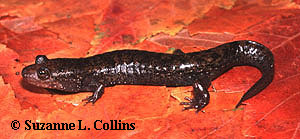
My research included identification of bugs that had been first eaten by quail, then stored in a freezer for twenty years. When I’d find some mashed-up bug part I couldn’t identify, I’d drag it down to George, who could usually name it on sight. If he couldn’t, he’d drag out a microscope and a stack of guidebooks, and quickly figure out whose wing or chunk of exoskeleton I’d brought him. It seemed to me, and to everyone around me, that there was nothing that George didn’t know. If, however, you said such a thing to him, he’d wave his hand and say, “Awwww. Not true.” On top of everything else, George was humble. Maybe the only time I saw him a bit prideful was when he found out that a salamander (
Desmognathus folkertsi) had been named after him; for a field biologist, this is the greatest honor one can receive.
After I got off the phone with Matt, I sat on the bed and cried a little. Two days later I drove to Auburn, and arrived in time for the visitation at George’s church, Trinity Lutheran. Amy and I stood in line together for over an hour to speak to Debbie for a moment—there was a crowd as if some president or foreign dignitary had died. While we stood in line, people brought us cookies and beer. A slide show on one wall displayed pictures of George having Christmas with his children, or up to his neck in swamp water, or standing in the university arboretum that he had saved from destruction almost single-handedly.
The next day was the funeral. I sat up in the balcony with Amy, Matt, and Mark. George’s pastor said a word or two—he made us sing, like George would have—and then there was sort of an open mic. People got up and said a word or two about George, and told some of the things he had taught them. One of Debbie’s sisters read a paragraph or two that Debbie had written.
I didn’t get up and talk—I don’t think I would have been able to speak coherently. George taught me so many things, and many of them didn’t have much to do with insects, or birds, or salamanders. He did so many things for me that I haven’t mentioned here—for instance, he was instrumental in helping me get my dream job. I never properly thanked him—when I tried, he just waved his hand and said “Awwww.” So…
George, you showed me the proper way to conduct a classroom—with humor, and grace, and humility. Every day I get up and teach, I copy your style, and half the time I’m stealing your lectures. If I’m half the teacher you were, then I owe you thanks. You taught me that the tiniest things in a biological community were often the most important. You told me that I could never understand an ecosystem unless I got out and lived in it. You told me to just stop and look at the animal I was studying—to think about its place in nature—to take it all in. If I’m one-fifth the scientist you were, thanks. You taught me to think about my place in the community, and to care for the people around me, and to use my brain to try to be happy. If I’m one-tenth the person you were, then thanks for that.
Thanks, George.
 Republican Nutcase Presidential Candidate Mike Huckabee has declared his intention to end the secular nation that originated with the ratification of the United States Constitution. According to an article on rawstory.com: